

Why Inflation Makes Sitting on Cash Your Biggest Risk
Have you checked your bank balance recently and felt reassured because the number hasn’t gone down? That feeling is misleading you. If you’ve kept meaningful savings sitting in a bank account over the past few years, you’ve already lost money. That’s the strange, quiet nature of inflation: it doesn’t show up as a withdrawal. It shows up as your money buying less than it used to, month after month, without you ever touching it.
Understanding what inflation actually is, what causes it, and what happens when it spirals out of control is the foundation for one of the most important decisions you’ll ever make with your money: whether to stay in cash or put it to work.
What Is Inflation?
In its simplest terms, inflation is the sustained devaluation of a fiat currency, which leads to a rise in the general level of prices across an economy. As prices rise, each unit of currency buys less than it did before; your yen, dollar, or euro simply doesn’t stretch as far as it used to. Economists typically track inflation using a measure such as the Consumer Price Index (CPI), which tracks the cost of a basket of everyday goods and services over time.
A little inflation, in the 2 to 3% range that most central banks target, is generally considered healthy. It’s the sign of a growing, functioning economy. It’s high enough that it encourages businesses and people to put their money to work, without devaluing the currency too quickly.
The opposite of inflation is deflation, which is a sustained fall in prices. It sounds appealing on the surface (who doesn’t like lower prices and higher purchasing power?), but as we’ll get to, deflation carries its own serious problems, and Japan knows this better than almost any country globally.

Today, America’s money printers are working harder than ever. There is now more money in circulation in the US than at any point in its history, over $23 trillion.
What Causes Inflation?
Inflation is usually driven by one or a combination of a few core forces.
Excess money supply growth (money printing). When the amount of money circulating in an economy grows faster than the actual output of goods and services, it results in simply too much currency chasing the same amount of stuff. Prices of goods and services rise to absorb the difference.
Demand-pull inflation. This happens when demand for goods and services outpaces what the economy can supply, meaning too many buyers and not enough goods and services available. A good example is the post-pandemic economic recovery in 2021, when the government gave people extra money and consumer spending spiked; everyone wanted to buy things at the same time. Factories and shipping lines could not produce or move goods fast enough, so prices rose as too many buyers chased too few items.
Cost-push inflation. Here, the prices of inputs, like energy, labor, and raw materials, rise, and businesses pass those higher costs on to consumers. A relevant example here would be the rise in oil prices due to disruptions in the Strait of Hormuz caused by the conflict with Iran.
Loss of confidence in the currency. In more extreme cases, people simply stop trusting that their currency will hold its value and will rush to spend it or convert it into something else before it loses its value. This is often the tipping point that turns ordinary inflation into hyperinflation. It is like a bank run on a national scale, and it quickly leads to a loss of value in the fiat currency in question.
That last point is where things get dangerous, and history has given us some vivid examples of what happens when it spirals out of control.
Why Is Too Much Inflation Bad?
While moderate inflation is considered desirable, excessive inflation can be a double-edged sword, affecting different populations in different ways. Here’s how inflation affects individuals, families, and businesses.
Flexibility and instability. Inflation rates are constantly changing and are very unpredictable. This may make it difficult for businesses to plan their budgets and investments, as the cost of supplies and wages can vary unexpectedly. As a result, this uncertainty can discourage business investment, negatively impacting economic growth.
Loss of purchasing power. Inflation is a silent form of taxation on the general population, often resulting from governments printing money to cover budget deficits. When prices rise, consumers find that their money doesn’t stretch as far as it used to, which can lead to a decrease in the standard of living. For people on fixed incomes, such as retirees and employees, this can be particularly devastating, as they will be the last in line to have their incomes adjusted, if at all.
Income inequality. Inflation hits lower-income households particularly hard, as they earn by the hour and must spend a larger share of their income on essential items. On the other hand, wealthier households have greater financial leeway and can better manage price increases. Wealthier households also tend to hold more of their wealth in assets such as property and stocks, and those assets tend to rise in value relative to the currency’s decline, whereas lower-income households tend to be asset-poor.
While incomes tend to rise alongside inflation over the long run, in certain periods that does not happen, and even a modest, multi-year stretch of stagnant pay against rising prices can quietly erode a household’s purchasing power. US median household income, for example, barely moved between 2008 and 2013 while the cost of living kept climbing.¹ And even when incomes do rise on average, they do not rise the same way for everyone: hourly workers, people between jobs, and retirees on a fixed pension are often the last to see any adjustment at all, if they see one.
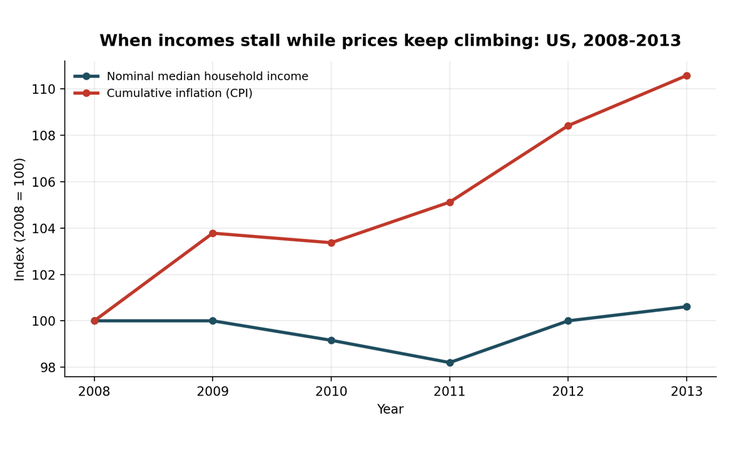
US median household income vs. cost of living, 2008 to 2013 (Census Bureau data)
When Inflation Goes Extreme

Germany’s100 trillion mark note, a number too big even for Dr. Evil. By late 1923, banknotes had become so worthless that Germans needed wheelbarrows just to carry enough cash for daily shopping.
Weimar Germany (1922 to 1923). After the First World War, Germany was saddled with massive reparations payments it could not afford. Rather than raise taxes or cut spending, the government printed money to cover the gap. The results were staggering. In January 1923, one US dollar was worth 17,000 marks. By August, it was 4.6 million. By November, over a trillion. By December, the exchange rate had topped out at 4.2 trillion marks to the dollar. A German student at the time recalled ordering a cup of coffee for 5,000 marks, and being told the price had risen to 7,000 marks by the time he ordered his second cup. Prices were changing within seconds.
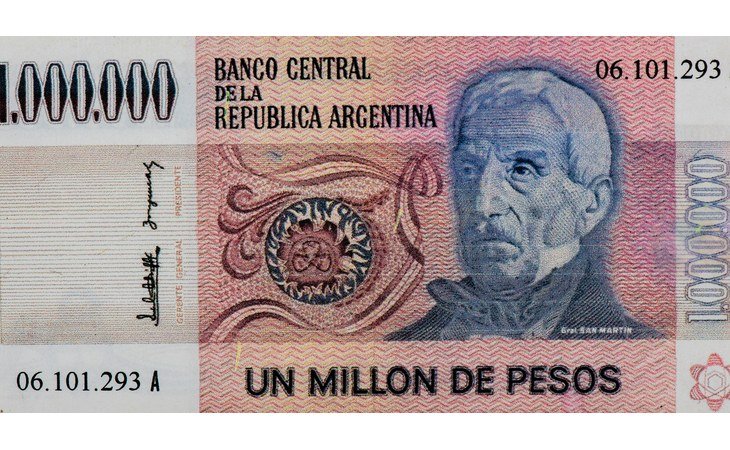
A one million peso Argentine note. The currency racked up so many zeroes to inflation that the country had to launch an entirely new currency, the austral, in 1985, only to see history repeat itself and return to the a new peso in 1992.
Argentina (1980s to present). Argentina offers a more familiar, drawn-out version of the same story: a government making spending promises it can’t fund over decades by turning to the money printer to bridge the gap. Once one of the world’s wealthiest nations, Argentina regularly competed for the world’s highest inflation rate from the end of the Second World War through the 1990s, with various governments printing money to make up for their spending. In 2023, Argentina’s annual inflation rate was 211%, the country’s highest in three decades. This gave the country a reputation for being a serial defaulter.
Decades of currency instability reshaped everyday life in Argentina in ways that went beyond rising prices. With inflation eroding any long term promise a peso could make, mortgages effectively disappeared for ordinary households, since no bank could lend money for 20 or 30 years in a currency that might be worth a fraction of itself within months, pushing homeownership largely out of reach without cash or foreign currency savings. That same uncertainty made it nearly impossible for families and businesses to plan more than a few months ahead, turning basic decisions like saving for retirement or investing in a business into a guessing game. Faced with currency that couldn’t reliably store value and an economy that offered little stability, hundreds of thousands of Argentines, many of them highly educated professionals, emigrated in search of steadier ground, a brain drain that has cost the country a generation of talent it can’t easily replace.
Interestingly, since taking office in December 2023, President Javier Milei has taken a different approach: cutting spending instead of printing to cover it. Argentina posted back-to-back fiscal surpluses in 2025 and 2026, its first in nearly two decades, and annual inflation fell sharply from that 211% peak.² It’s an early, live test of the same lesson in reverse: spend less and stop printing, and the currency starts to recover.

Not to be outdone by Germany, Zimbabwe had their one 100 Trillion Dollar note. Issued in January 2009, it was worth around US$30 the day it entered circulation.
Zimbabwe (2007 to 2008). This is the most extreme modern case on record. At its peak in November 2008, Zimbabwe’s monthly inflation rate hit an estimated 79.6 billion percent, a daily inflation rate of roughly 98%, meaning prices were doubling approximately every 24 hours. The image of Zimbabweans pushing wheelbarrows full of near-worthless bills just to buy a loaf of bread isn’t an exaggeration, but a well-documented reality from that period. Unemployment reached close to 80%, and ordinary economic life effectively broke down.
However, Zimbabwe’s annual inflation rate has since fallen dramatically.³ This stabilization followed the introduction of the gold-backed Zimbabwe Gold (ZiG) currency in 2024, which helped limit the Reserve Bank of Zimbabwe’s unbacked money creation through very strict financial rules, marking a rare period of single-digit inflation after decades of severe hyperinflation.
In each of these cases, the pattern is similar. A government overpromises, overspends, and then can’t or won’t raise the money honestly through taxes or borrowing, and prints its way out, transferring the cost onto anyone holding that currency as cash.

Tokyo’s Ginza district, whose land once traded for more per square meter than anywhere on earth.
The Other Side: Japan’s Deflation Problem
It would be easy to walk away from those examples thinking inflation is the only danger. Japan’s experience tells a different story. To understand why, it helps to see how extreme the bubble itself was.
Through the second half of the 1980s, the Bank of Japan held interest rates at historic lows, cutting its discount rate from 5% to 2.5% in 1987, partly in response to the 1985 Plaza Accord’s currency alignment. Cheap credit poured into stocks and real estate: the Nikkei stock index nearly quadrupled, and Tokyo land prices climbed so far that the land beneath the Imperial Palace alone was worth more than the entire state of California. It was a mirror image of the inflation stories above: instead of a currency losing value as too much money chased too few goods, asset prices inflated as too much cheap credit chased a fixed supply of stocks and land.
After Japan’s asset price bubble burst in 1990, the country spent what became known as the “Lost Decades” battling the opposite problem: deflation. Prices fell or stagnated for years at a time. On paper, that might sound like a win for savers. In practice, it was corrosive. When prices are falling, people and businesses learn to wait. Why buy something today if it’ll be cheaper next month? That hesitation drags down spending and investment, which slows the economy further, which puts more downward pressure on prices, a self-reinforcing cycle that’s notoriously difficult to break.
Deflation also quietly does something brutal to debt: as prices fall, the real value of what’s owed grows, even though the number on the loan statement never changes. For a heavily indebted government or heavily indebted households, that’s a serious problem. This is a big part of why most governments deliberately target mild inflation rather than aiming for flat or falling prices. A little inflation gently erodes the real value of what a government owes over time. In some ways, mild inflation is less an economic accident and more a deliberate policy choice.
Decades after the bubble burst, Japan has now swung to the opposite side of that ledger. A weaker yen and rising import costs have pushed the country back into the kind of inflationary environment it hadn’t seen in a generation, a striking reversal after so many years spent fighting falling prices.

The yen may be down, but Shibuya’s tourist traffic has never been higher.
Current Inflationary Situation in Japan
The Bank of Japan has been raising interest rates as a weak yen and rising import costs push inflation higher. For anyone living in Tokyo, the numbers behind headlines are easy to recognize without a chart: property prices are at record highs, rents have been climbing for a few years straight, and the supermarket bill looks noticeably different from what it did a couple of years ago. The yen has lost roughly a third of its value against the dollar over the past five years.
That shows up most directly at the grocery store: food inflation ran at roughly 7% in 2025, with rice prices especially volatile amid poor harvests and rising import costs. Wages, meanwhile, haven’t kept pace, so purchasing power for yen earners has quietly slipped. For a generation of Japan based savers used to holding cash, or even seeing its value grow, during decades of deflation, that shift matters.
That same currency weakness cuts two ways. It makes travel abroad and anything imported more expensive for yen earners, while making Japan one of the more affordable major destinations for foreign visitors and buyers, tourist arrivals are at record highs, and foreign buyers now drive close to a fifth of condo purchases in central Tokyo, pushing new condo prices there up nearly 20% in a year. The mismatch has bred real friction on the ground, as tourist crowds strain neighborhoods and housing costs squeeze residents already stretched thin, prompting Kyoto and the national government to respond with steeper lodging and departure taxes aimed at visitors rather than residents.
This has become a live policy question rather than something households simply absorb quietly. Officials have floated currency intervention to counter the yen’s weakness directly, while the Bank of Japan’s rate hikes reflect the same tension: raise rates too slowly and imported inflation keeps squeezing wage earners, raise them too fast and the debt heavy economy risks a much rockier landing.

Purchasing power of ¥100 at a steady 3% annual inflation rate (illustrative model)
How to Protect Yourself
The common thread running through every example above is that cash sitting idle is never a neutral choice. It quietly loses real value over time, even in mild inflationary environments. We’re not living through Weimar or Zimbabwe, but most countries are now looking to print to inflate their way out of debt, and it’s more likely than not that inflation will continue to rise, regardless of the country or currency.
That’s why, before your money starts losing its value, it is crucial to avoid holding too much cash and instead consider investing in productive assets, meaning assets that generate income or grow in line with the businesses and economies behind them.
Equities and diversification:
Equities give you a claim on companies whose revenues and profits tend to rise alongside prices, which is part of why stock markets have historically outpaced inflation over long stretches of time, even though they carry more short-term volatility than cash. The same logic applies to geography and currency, not just asset type: a portfolio can hold a good mix of assets and still be concentrated if it all sits in one country or one currency, since a weak yen or a bout of local inflation touches everything you own at once. Diversified funds and ETFs make broad exposure practical, letting a saver hold companies across multiple countries and currencies in a single position, which for savers holding mostly JPY denominated assets is a natural hedge against exactly the kind of currency and inflation risk this article describes.
Real Estate
Property can provide both price appreciation and rental income that has historically tracked or outpaced inflation over long periods. Rents have been climbing steadily in recent years, and for investors that means the ability to raise rent as costs rise, giving property income a built-in edge over cash that inflation only erodes. Tokyo has been a clear example, with property prices in the capital hitting record highs in recent years.Neither is a guarantee, and both carry risks that need to be weighed against your goals, timeline, and how much volatility you can tolerate, but historically they have preserved and grown purchasing power in ways idle cash cannot.
Other real assets can offer protection, too. Art and collectibles, precious metals, and, more recently, cryptocurrencies are sometimes discussed as inflation hedges. Gold has the longest track record, since its supply can’t be expanded the way governments print currency. Cryptocurrencies are sometimes called “digital gold” for their capped supply, but they’ve historically been far more volatile and have a much shorter track record against inflation.
Each of these options carries its own trade-offs worth understanding first, and getting the mix right depends on variables that are genuinely personal: your timeline, how much volatility you can stomach, what currencies and assets you’re already exposed to, and what you’re ultimately saving for. That’s a lot to weigh correctly on your own, and small missteps in a plan like this tend to compound quietly over years rather than show up right away. Figuring out how to protect your savings from inflation, while still managing that risk appropriately for your goals and timeline, isn’t a decision to make alone.
At Argentum Wealth, we help expats and foreigners living and working in Japan build portfolios designed to preserve and grow purchasing power over time. If you’d like help, get in touch for a free initial consultation and take a look at our other resources, including our article on Navigating Lifestyle Inflation, and our piece on the Power of Compound Interest.
Argentum Wealth does not provide tax, legal or accounting advice. This material has been prepared for informational purposes only, and is not intended to provide, and should not be relied on for, tax, legal or accounting advice. You should consult your own tax, legal and accounting advisors before engaging in any transaction.
Argentum Wealth Management is licensed through the Japanese Financial Services Authority to give financial advice. The FSA strongly recommends that you only receive financial advice and services from a locally licensed and regulated firm.
Frequently Asked Questions
What is inflation?
Inflation is a sustained rise in the general level of prices across an economy, meaning each unit of currency buys less over time. It’s typically tracked using the Consumer Price Index (CPI), which measures the cost of a basket of everyday goods and services, and a little inflation, around 2 to 3%, is generally considered a healthy sign of a growing economy.
What causes inflation?
Inflation is usually driven by excess money supply growth, demand-pull inflation (too many buyers chasing limited goods, as seen after pandemic-era stimulus spending in 2021), cost-push inflation (rising input costs like oil, such as disruptions in the Strait of Hormuz getting passed on to consumers), or a broader loss of confidence in a currency’s value.
Who is hurt most by inflation?
Inflation affects people unevenly. It creates budgeting uncertainty for businesses, erodes purchasing power for everyone (especially those on fixed incomes like retirees), and tends to hit lower-income households hardest, since they spend a larger share of income on essentials and hold fewer appreciating assets like property or stocks compared to wealthier households.
What is hyperinflation, and has it really happened?
Hyperinflation is extreme, rapid inflation usually caused by a government printing money to cover spending it can’t otherwise fund. Historical examples include Weimar Germany in 1923 (one US dollar rose from 17,000 to 4.2 trillion marks in a year) and Zimbabwe in 2008, where monthly inflation peaked near 79.6 billion percent.
Have Argentina and Zimbabwe recovered from their hyperinflation crises?
Both offer recent recovery examples. Argentina’s inflation fell from a 211% peak in 2023 to roughly 33% by mid-2026 after President Javier Milei cut government spending instead of printing money, posting back-to-back fiscal surpluses. Zimbabwe’s annual inflation dropped to 3.2% by July 2026 following the 2024 introduction of the gold-backed Zimbabwe Gold (ZiG) currency, which limited unbacked money creation.
Why was Japan’s deflation just as damaging as inflation?
After Japan’s asset price bubble burst in 1990, following a 1980s boom where cheap credit inflated stocks and land prices to extremes, the country spent its “Lost Decades” battling falling prices. Deflation encourages people to delay spending and investment, slows economic growth, and increases the real value of existing debt over time, which is why most governments deliberately target mild inflation rather than none at all.
What’s happening with inflation in Japan right now, and how can I protect my savings?
In mid-2026, the Bank of Japan raised interest rates to 1%, the highest since 1995, as a weak yen and rising import costs pushed food inflation to roughly 7% and property prices to record highs, while wages lagged behind. Historically, holding productive assets like equities and real estate has preserved and grown purchasing power over time in a way idle cash cannot.
Other Articles
Tokyo's 2023 Real Estate Boom: Why Property Values Are Soaring
6 Ways Time In The Market beats Timing the Market
Tax-Aware Investing for Americans in Japan
Life Insurance for Expats in Japan: How Much Cover Do You Need?
Managing US 401K & IRA Accounts from Japan
Why Setting Beneficiaries on Your Investment Accounts Matters









Email: [email protected]
JP Ph: +81 (03) 5549-9099
US Ph: +1 (929) 488-1488
SD22 Bldg, Unit 802,
1-11-10 Azabudai, Minato-Ku,
Tokyo 106-0041